
Design Thinking Training – Advanced Level
Five days to acquire the method, tools and reflexes that turn innovation from intention into action, starting from your customers’ real needs. A full day per phase (Empathise, Define, Ideate, Prototype, Test) to practise each tool, understand when to use it and apply it directly to your projects. Not a quick overview but full immersion: your team gains a shared approach to innovation.
The problems you recognise
Course content
DAY 1
Empathise — Understand before you create
Observe, listen, immerse yourself. You discover and practise different techniques for gathering information from your users. You learn to build an empathy interview guide, conduct in-depth interviews and go into the field to grasp what users truly experience.
Tools practised:
Empathy interview guide · Empathy interview · Field observation · Immersion
DAY 2
Define — Frame the problem worth solving
Your field observations are only valuable if you know what to do with them. This day is dedicated to synthesis: you learn to structure what you have seen and heard, build a clear picture of your users, and reframe problems as concrete opportunities with the How Might We technique.
Tools practised:
Persona · Empathy map · Customer journey · How Might We
DAY 3
Ideate — Generate, diverge, converge
Beyond classic brainstorming. You discover structured techniques (Crazy 8s, SCAMPER, creative analogies) to stimulate your team’s creativity and move beyond predictable ideas. Then you learn to converge with method: prioritise, vote, and choose the idea worth prototyping. Effective ideation can be learned.
Tools practised:
Crazy 8s · SCAMPER · Creative analogy · Dot voting
DAY 4
Prototype — Give shape to the idea, fast
You discover different ways to give shape to a project, from the simplest to the most elaborate, to test quickly without unnecessary investment.
Tools practised:
Paper prototype · Storyboard · Video · AI tools · Mock-ups / Wireframes · Role play
DAY 5
Test — Learn from user feedback and decide
You structure a user testing session, gather useful feedback and decide what to iterate on, or what to drop.
Tools practised:
User test guide · Observation grid
What you gain
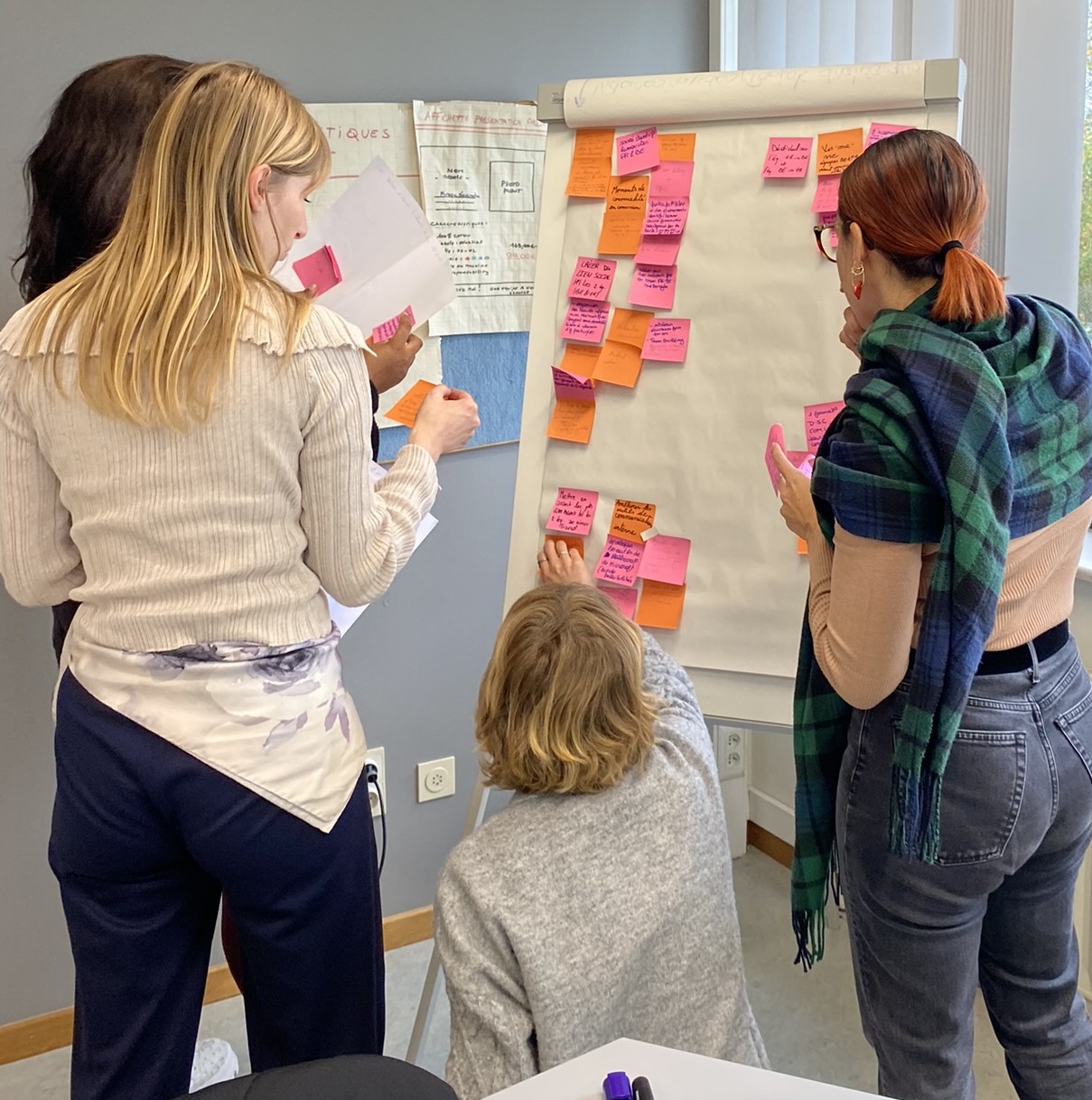
Phase-by-phase mastery
A full day per stage, enough time to understand, practise and embed each tool.
A toolkit of concrete techniques
For each phase, several techniques you can apply to your projects the following week.
Practice on your real challenges
No fictional case: you work on issues from your own professional context.
Format & logistics
Ideally an even number
Who is it for?
Frequently asked questions
Do you need prior Design Thinking experience to sign up?
No, there are no prerequisites. The course starts from the fundamentals of each phase before going into depth.
Do the five days have to be consecutive?
Not necessarily. The pace adapts to your organisation: five consecutive days for full immersion, or days spread out so the team can experiment between sessions.
Do we work on our real projects or on fictional cases?
On your real projects. It is one of the founding principles of this course: you apply the tools directly to your professional challenges.
What is the difference with the Bootcamp?
The Bootcamp goes through the five phases in one day on a standard challenge: it is a discovery. The advanced level devotes a full day to each phase, with a range of tools and practice on your real projects. It is the difference between glimpsing a territory and truly exploring it.
What if your team innovated from your customers?
Get in touch to organise this training course in your organisation.
Discover my other training courses
TRAINING
UX Research & Customer Empathy
Learn to interview, observe and test with your customers to build a real culture of empathy in your team.
TRAINING
Design Thinking Bootcamp
Discover in a single day how to innovate from your customers’ needs, from the first interview to a tested prototype.